
John Kotter (1996), a Harvard Business School Professor and a renowned change expert, in his book “Leading Change”, introduced 8 Step Model of Change which he developed on the basis of research of 100 organizations which were going through a process of change.
The 8 steps in the process of change include: creating a sense of urgency, forming powerful guiding coalitions, developing a vision and a strategy, communicating the vision, removing obstacles and empowering employees for action, creating short-term wins, consolidating gains and strengthening change by anchoring change in the culture. Kotter’s 8 step model can be explained with the help of the illustration given below: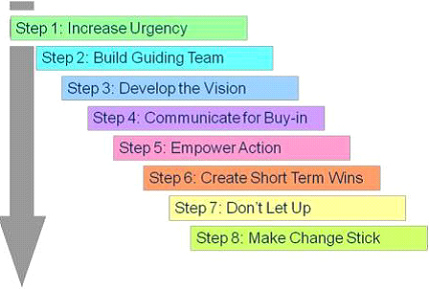
(Source: Adapted from Kotter 1996)
- Creating an Urgency: This can be done in the following ways:
- Identifying and highlighting the potential threats and the repercussions which might crop up in the future.
- Examining the opportunities which can be tapped through effective interventions.
- Initiate honest dialogues and discussions to make people think over the prevalent issues and give convincing reasons to them.
- Request the involvement and support of the industry people, key stakeholders and customers on the issue of change.
- Forming Powerful Guiding CoalitionsThis can be achieved in the following ways:
- Identifying the effective change leaders in your organizations and also the key stakeholders, requesting their involvement and commitment towards the entire process.
- Form a powerful change coalition who would be working as a team.
- Identify the weak areas in the coalition teams and ensure that the team involves many influential people from various cross functional departments and working in different levels in the company.
- Developing a Vision and a StrategyThis can be achieved by:
- Determining the core values, defining the ultimate vision and the strategies for realizing a change in an organization.
- Ensure that the change leaders can describe the vision effectively and in a manner that people can easily understand and follow.
- Communicating the Vision
- Communicate the change in the vision very often powerfully and convincingly. Connect the vision with all the crucial aspects like performance reviews, training, etc.
- Handle the concerns and issues of people honestly and with involvement.
- Removing Obstacles
- Ensure that the organizational processes and structure are in place and aligned with the overall organizational vision.
- Continuously check for barriers or people who are resisting change. Implement proactive actions to remove the obstacles involved in the process of change.
- Reward people for endorsing change and supporting in the process.
- Creating Short-Term Wins
- By creating short term wins early in the change process, you can give a feel of victory in the early stages of change.
- Create many short term targets instead of one long-term goal, which are achievable and less expensive and have lesser possibilities of failure.
- Reward the contributions of people who are involved in meeting the targets.
- Consolidating Gains
- Achieve continuous improvement by analysing the success stories individually and improving from those individual experiences.
- Anchoring Change in the Corporate Culture
- Discuss the successful stories related to change initiatives on every given opportunity.
- Ensure that the change becomes an integral part in your organizational culture and is visible in every organizational aspect.
- Ensure that the support of the existing company leaders as well as the new leaders continue to extend their support towards the change.
Advantages of Kotter’s Model
- It is an easy step by step model which provides a clear description and guidance on the entire process of change and is relatively easy for being implemented.
- Emphasis is on the involvement and acceptability of the employees for the success in the overall process.
- Major emphasis is on preparing and building acceptability for change instead of the actual change process.
Disadvantages of Kotter’s Model
- Since it is a step by step model, skipping even a single step might result in serious problems.
- The process is quite time consuming (Rose 2002).
- The model is essentially top-down and discourages any scope for participation or co-creation.
- Can build frustration and dissatisfaction among the employees if the individual requirements are given due attention.